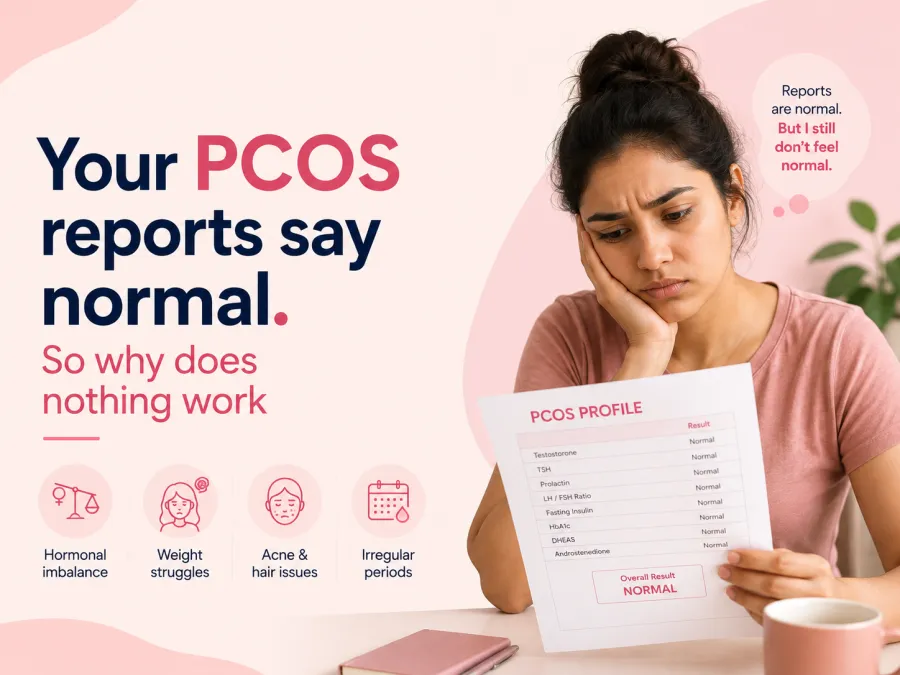
You did the diet. The one that worked for your friend in six weeks. You did it for four months and nothing moved.
You got the tests done. The report said normal. The doctor read it for ninety seconds and told you to lose some weight and come back.
Somewhere in there, you started wondering if the problem is you.
It isn't. For many women with PCOS there is a measurable reason the weight won't shift: a hormone called insulin that the body has stopped responding to. And the test that catches it is usually not the test that gets ordered. That is why your report said normal.
You are also not rare. A meta-analysis pooling 11 Indian studies put PCOS at roughly 11 in every 100 Indian women, and among Indian adolescent girls the pooled figure was close to 1 in 5 (Cureus, 2022; PMC, 2021).
You're not imagining this
You are not lazy. You have almost certainly worked harder for smaller results than the people around you.
The hunger is real hunger. The tiredness is real tiredness. Snapping at someone when a meal is late is a blood sugar swing, not a character flaw.
And the parts that never make it into medical articles: the hair in the drain you've stopped mentioning, the relative who announces your weight at every function, the advice that it'll sort itself out after marriage, the waxing appointments scheduled around your face.
That's a hormonal condition doing what it does. It has a mechanism, and the mechanism can be measured.
What's actually happening
Insulin is a key.
Food becomes sugar in your blood. Insulin is the key that opens your cells so the sugar can go in and be used.
In many women with PCOS the lock has gone stiff. The key won't turn easily, so the body makes more and more keys. Now there's extra insulin circulating all day.
That extra insulin does two things. It pushes your ovaries to make more male hormone, which is the acne, the scalp hair fall, the facial hair, the unpredictable periods. And it switches your body into storage mode, because insulin's job is to tell the body to save rather than spend.
Read that again, because it changes everything: the acne, the facial hair, the missing periods and the stubborn weight aren't four separate things you're failing at. For many women they're one thing showing up in four places.
Which is also the hopeful part. Improve the one thing, and several improve together.
How common is this? Published estimates put insulin resistance and the raised insulin that comes with it at roughly 65 to 70 percent of women with PCOS, with something in the region of 70 to 80 percent among women in the higher BMI range and 20 to 25 percent among lean women (Fertility and Sterility). Treat those as broad estimates rather than precise figures: they vary considerably between studies depending on how insulin resistance was measured and which population was studied.
Two honest notes follow from that. Not every woman with PCOS has an insulin problem. A meaningful minority have completely normal insulin and a different cause, which is why you test rather than assume. And this happens at normal weight too. Slim women with PCOS exist, they can be insulin resistant, and they get diagnosed years late because nobody suspects it.
There is one more thing that matters specifically for Indian women. Indian consensus guidelines use lower BMI cut-offs than the international ones, with overweight starting around 23 rather than 25, and a waist measurement of 80 cm or more counting as abdominal obesity in women (Nutrients, 2013). South Asians tend to carry more visceral fat and show more insulin resistance at the same BMI as white European populations (PMC). In plain terms: a BMI that looks fine on a standard chart does not rule this out for you.
So the diets didn't fail because you did. They were written for a body that handles insulin normally. Yours may not.
The test that gets missed
Here is the one line worth taking away: your sugar can stay normal for years while your insulin quietly runs high to keep it there.
Which means a normal sugar report doesn't rule out an insulin problem. It just means nobody looked at insulin.
Ask for these, by the names your lab will recognise:
- Fasting insulin (Insulin Fasting, Serum Insulin on an Indian report): the one usually left out. Catches the problem years before sugar changes.
- Fasting sugar (FBS, Glucose Fasting): read together with insulin, not alone.
- Post-meal sugar (PPBS, Glucose PP): rises before fasting sugar does.
- 3-month average (HbA1c): useful background, not sensitive enough by itself.
- Testosterone + SHBG (T. Testosterone, SHBG): low SHBG with normal testosterone still tells a story.
- Thyroid, prolactin (TSH, S. Prolactin): rules out conditions that look like PCOS.
- Metabolic set (Lipid profile, LFT, RFT, CBC): insulin trouble and fatty liver often travel together.
Getting it done right: fast 8 to 12 hours, water only, no chai and no "just one biscuit." Book a morning slot. Ask about cycle timing before booking, since some hormone tests are usually done in the first few days of a period; if your cycles are irregular, your doctor will tell you what to do instead. Don't test while you're unwell. Do it all in one visit: one fast, one needle, one report you can read together.
Reading the report without spiralling
- Use your own report's range column, not one from the internet. Ranges differ between labs. A number flagged high at one may sit inside the range at another.
- "Normal" isn't always "clear." Normal sugar with high fasting insulin is a real finding, not a clean bill of health. This is the exact combination that gets missed.
- One flagged number isn't a diagnosis. PCOS is diagnosed on symptoms, history and results together. Try not to spend the night before your appointment reading about a single red mark.
- Take the whole report in, not a photo of one line.
What changes after you know
You stop guessing. If insulin is part of your picture, the focus moves to what improves insulin sensitivity, and because insulin sits upstream of so much of PCOS, that usually helps several symptoms at once. If it isn't, you've saved yourself two more years of chasing the wrong thing.
Most women notice the small things first: energy that doesn't collapse at 4pm, cravings that stop running the evening. Those arrive well before the weighing scale does, which is worth knowing, because otherwise it's easy to decide nothing is working when something already is.
Straight talk: PCOS doesn't vanish, and anyone selling you a cure isn't being honest. But long-term isn't the same as stuck. The women who do best usually aren't the ones with the strictest diet. They're the ones who finally found out what was going on. If you want a doctor to actually look at the whole picture, insulin included, that is exactly what a consult with a metabolic panel is built for.
When to see a doctor
Book an appointment if your periods come more than 35 days apart or skip months; you're gaining weight that doesn't match what you eat; you have adult-onset acne, hair fall or facial hair; you've been trying to conceive without success; diabetes runs in your family alongside any of the above; or you were diagnosed with PCOS and nobody ever tested your sugar and insulin.
That last one is extremely common. A PCOS diagnosis without a metabolic workup is an unfinished diagnosis, and you're allowed to ask for the rest of it. If you haven't read it yet, our piece on PCOS and weight covers the bigger picture this one zooms in on.
Questions women ask us
My reports came back normal. Why do I still feel like this?
Most likely because fasting insulin was never tested. Sugar often stays normal for years while insulin runs high behind it.
Can you have PCOS if you're slim?
Yes, and it's common. Estimates suggest somewhere around 20 to 25 percent of lean women with PCOS have raised insulin (Fertility and Sterility), and Indian BMI cut-offs are lower than the international ones anyway (Nutrients, 2013). Slim women are diagnosed late because nobody suspects it.
Do I have to lose weight before anyone will help me?
No. Being told to lose weight without being told why it's been so hard is a common and unsatisfying experience. Testing comes first, because it tells you what would actually work.
Can I get tested if my periods are irregular?
Yes. Some hormone tests are timed to the cycle, and your doctor will tell you what to do when cycles are irregular. It doesn't stop you getting tested.
Sources
- Prevalence of Polycystic Ovarian Syndrome in India: A Systematic Review and Meta-Analysis. Cureus, 2022.
- Systematic review and meta-analysis of PCOS among Indian adolescent girls aged 14 to 19. PMC.
- Nestler JE et al. All Women With PCOS Should Be Treated For Insulin Resistance. Fertility and Sterility.
- Misra A, Shrivastava U. Obesity and Dyslipidemia in South Asians. Nutrients, 2013.
- Reviews of the South Asian metabolic phenotype and insulin resistance. PMC.
This article is general information, not medical advice. PCOS differs between women; decisions about testing and treatment belong with a doctor who knows your history.