PCOS
Manage PCOS symptoms with a doctor who looks at your cycle, your weight, and your labs together - not just one number.
Start with a real consult
One private consult with a licensed doctor. No subscription, no lock-in - just the care this needs.
Talk to an expertFree1 in 9
Indian women of reproductive age have PCOS
Pooled prevalence 11.33%, Cureus, 2022
70%
of women with PCOS worldwide are undiagnosed
World Health Organization
33.6%
waited more than two years for a diagnosis
JCEM, n=1,385
47.1%
saw three or more doctors before anyone named it
JCEM, n=1,385
What's Included in Your PCOS Consult
Also included
PCOD and PCOS: what's the difference?
In practice, they describe the same condition. PCOD, polycystic ovarian disease, is an older term still used widely in India. PCOS, polycystic ovary syndrome, is the name used in current international guidelines. If your report says PCOD and a specialist says PCOS, nobody has changed your diagnosis.
The claim that PCOD is mild and PCOS is severe appears on many Indian sites but in no diagnostic guideline. What actually varies is your phenotype - which of the diagnostic features you have. That's covered further down, and it's far more useful to know about yourself than which label your clinic prefers.
Why the name itself is misleading: "polycystic" suggests cysts. There are no cysts in PCOS, only follicles that started to grow and stalled - a consequence of the hormone imbalance rather than its cause.
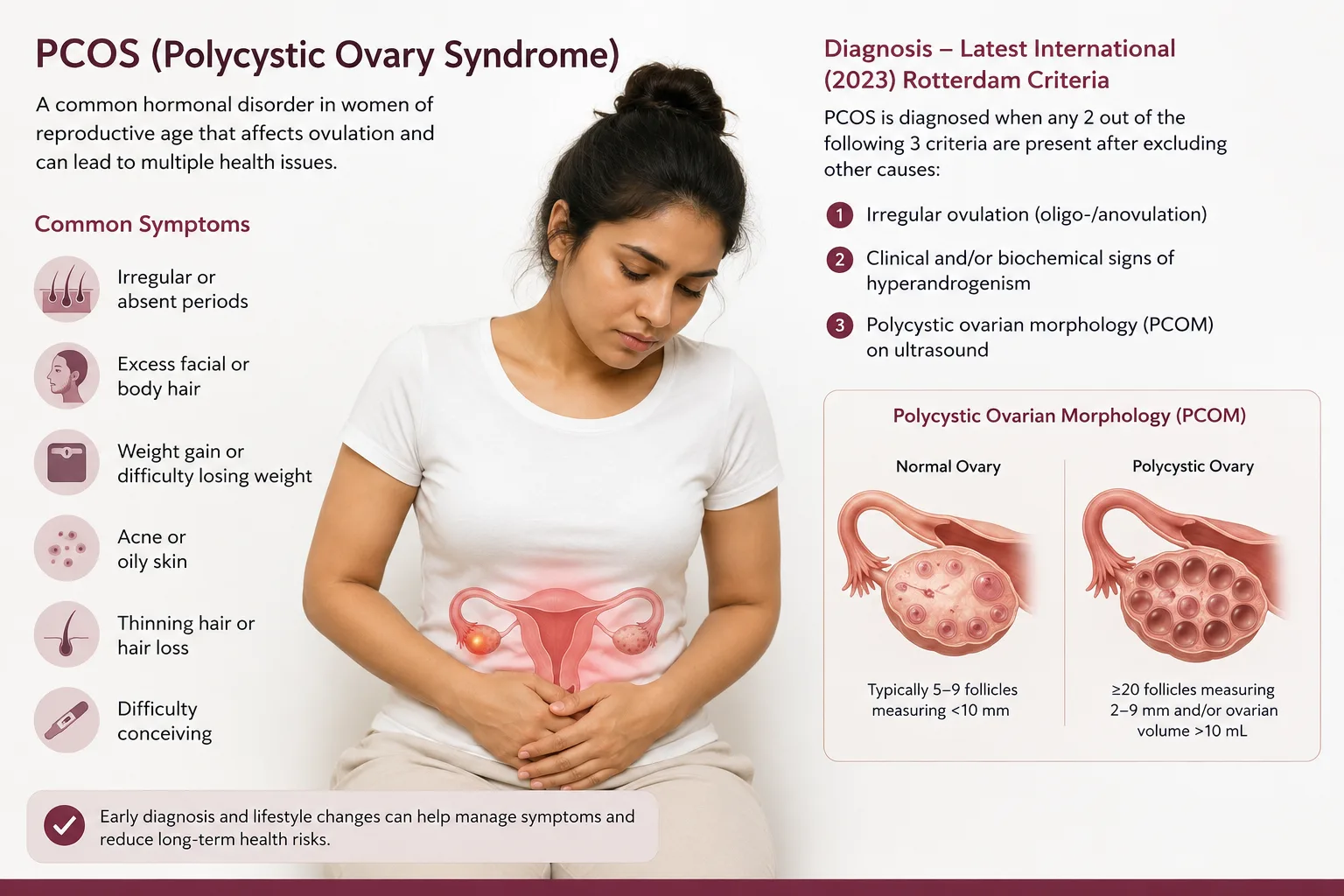
PCOS symptoms: what you notice, and what is causing it
Symptoms that seem unrelated, and get sent to unrelated specialists, are usually the same loop showing up in different tissue.
There are four types of PCOS
Diagnosis needs two of three features, which produces four combinations. Which one you have changes what to watch for.
This is why "you don't look like you have PCOS" means nothing. Two of the four types can present with regular-looking cycles or a clear ultrasound.
Which PCOS criteria do you meet?
Diagnosis needs any two of these three. Tick what applies to see where you sit.
Nothing selected yet.
This is a guide, not a diagnosis. Thyroid disease, high prolactin and late-onset congenital adrenal hyperplasia produce a nearly identical picture - PCOS is a diagnosis of exclusion.
The tests worth doing, and the ones to skip
A lot of money is spent on PCOS testing that current guidelines specifically advise against.
Worth doing
- A 75 g oral glucose tolerance test. The guideline calls it the most accurate way to assess glucose status in PCOS, regardless of your BMI.
- Lipid profile and blood pressure, at diagnosis and repeated over time.
- Thyroid function, prolactin and 17-hydroxyprogesterone, to exclude conditions that mimic PCOS.
- Total and free testosterone with SHBG, read together.
- A screen for depression and anxiety, in every patient.
Usually unnecessary
- Routine fasting insulin or HOMA-IR. Available assays are of limited clinical relevance for routine care.
- An ultrasound when irregular cycles and high androgens are both already present.
- AMH and an ultrasound together. Either one, never both.
- Any ovarian ultrasound within 8 years of a first period.
- An LH to FSH ratio used as proof. Neither necessary nor sufficient.
The same loop, left running for twenty years
PCOS is not only about periods and fertility. It is a long-range cardiometabolic condition.
Teens
The loop starts, quietly
Irregular periods get blamed on stress or exams. Acne goes to a dermatologist. Nothing connects.
20s
Symptoms build, blood sugar still looks normal
A routine fasting glucose usually reads normal here, which is exactly why it's falsely reassuring.
30s
Fertility brings it to a head
For many women this is when PCOS is finally named, a decade after it began. Metabolic syndrome was found in 30.6% of one South Asian PCOS cohort, against 6.34% of matched controls.
40s
The metabolic bill arrives
Across 99,892 women with PCOS and 446,055 controls, type 2 diabetes risk was roughly three times higher after adjusting for BMI, diagnosed about five years earlier.
Read this as leverage, not a verdict. Every one of those risks is modifiable, and modifiable earliest.
You are working on the loop, not on the scale
The 2023 guideline recommends lifestyle change for everyone with PCOS, and notes real benefits even when weight does not change.
Plate order
Protein and fibre before the carbohydrate
Dal, curd, paneer, eggs or sabzi before the rice or roti blunts the insulin spike that drives the loop. Easier to sustain than cutting out rice entirely.
Muscle
Resistance training, twice a week
Muscle is where most glucose is disposed of. More of it lowers the insulin needed for the same meal, whether or not the scale moves.
Carbohydrate quality
Lower the glycaemic load, don't fear carbs
Millets, whole dals, brown rice and vegetables raise glucose more slowly than refined flour and white rice. No food is banned.
Sleep and stress
Sleep is not the soft option
A few nights of short sleep measurably worsens insulin sensitivity. If snoring is loud, ask about sleep apnoea.
On PCOS treatment and medication: several medicines are used in PCOS depending on your type, goals, and whether you're planning a pregnancy. That's a decision for your treating doctor after a proper assessment.
Five things you were probably told
"Lose weight first, then we will look into it."
The loop makes weight harder to shift. Diagnosis does not depend on your weight.
"Your scan is clear, so you do not have PCOS."
A scan is one of three criteria and you only need two. Two of four PCOS types present with a normal-looking scan.
"Only overweight women get PCOS."
Lean PCOS is well recognised. Insulin resistance occurs independently of body size.
"It will sort itself out after marriage or a baby."
Pregnancy does not cure PCOS. The metabolic pattern persists and risks keep accumulating.
"You will not be able to have children."
PCOS is one of the most treatable causes of infertility. Ovulation is usually intermittent, not absent.
This article is general information, not medical advice. A doctor decides what is right for you in a consultation.
Have a question first?
Tap a question to ask Dr Jo directly - free, instant, no consult needed.
Dr Jo
Health Companion · Online
Hi, I'm Dr Jo - your health companion. I remember everything about your health, so ask me anything, any time, from symptoms to weight to sleep.
Free · Private · No commitment
Common questions
What is the difference between PCOD and PCOS?
In practice they describe the same condition. PCOD is an older term still common in India, while PCOS is the name used in current international guidelines. What genuinely varies is which of the three diagnostic features you have, giving four recognised PCOS types.
What exactly is PCOS?
PCOS - polycystic ovary syndrome - is a common hormonal condition that can affect periods, skin, hair, and weight. It looks different for everyone, and only a doctor can confirm a diagnosis.
Which foods help with PCOS?
Meals that keep blood sugar steady tend to help most - protein and fibre at every meal, and carbs paired with something rather than eaten alone.
Can I lose weight with PCOS?
Weight loss can be slower with PCOS - that's the condition, not your effort. Blood-sugar-steady meals and regular strength work help most people.
Why are my periods irregular with PCOS?
Irregular cycles are one of the most common PCOS signs, and they often shift alongside weight, stress and sleep. Tracking yours over a few months is where the pattern shows up.
Does PCOS affect fertility?
PCOS is one of the most common reasons ovulation becomes irregular, which can make conceiving take longer for some - though plenty of people with PCOS conceive. Anything about trying to conceive belongs with your doctor or a fertility specialist.
Should I get my insulin levels tested?
Usually not as a routine test. The 2023 guideline states that clinically available insulin assays are of limited clinical relevance and should not be used in routine care. A 75 g oral glucose tolerance test is recommended instead.
Ready to start?
Book a private consult with a licensed doctor, or talk to our care team first. No pressure either way.