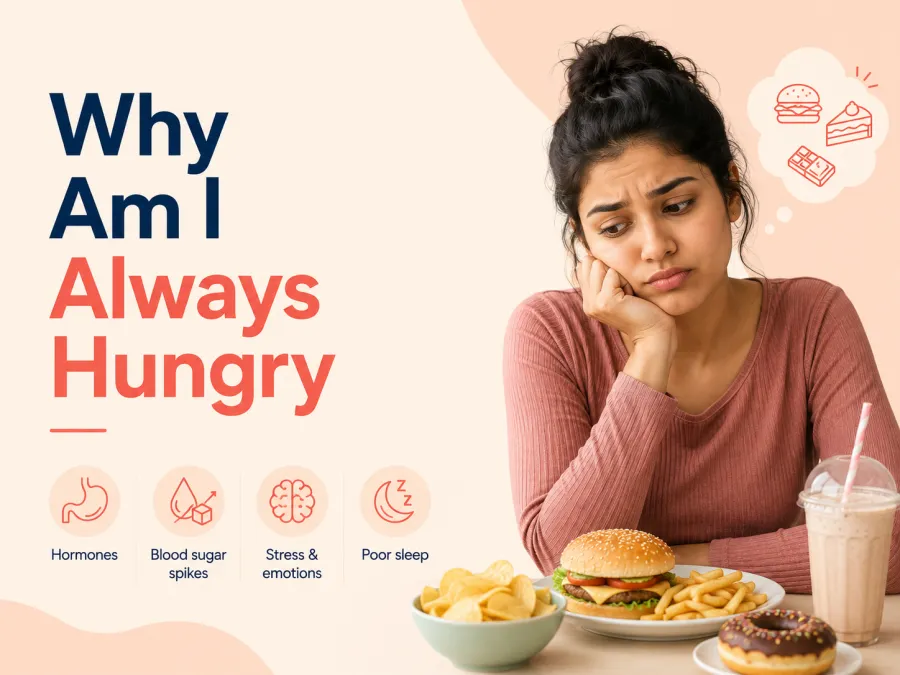
You finish lunch. Two hours later, you are hungry again. By 4pm you are hunting for biscuits. By 8pm you feel like you could eat anything. Most people blame themselves for this. They think they lack control. That is almost never the real story.
Think of hunger like a doorbell. The bell is not the problem. Someone pressed it. Your job is to find out who.
Hunger is a message from your body to your brain. It says, "we need fuel." That message is sent by hormones, which are chemical messengers in your blood. When those messengers are working normally, you feel full after a meal and stay full for hours. When they stop working properly, the doorbell keeps ringing, even when the house is full.
Remember this: feeling hungry all the time is a symptom. Like a cough or a headache, it has a cause. And most causes can be found and treated.
Constant hunger is usually a hormone problem, not a willpower problem. Blood sugar swings, too little protein, poor sleep, stress, and insulin resistance can all keep your hunger signals switched on. Fix the cause and the hunger settles. If it does not, a simple blood test can tell you why.
What actually controls your hunger
Four or five main hormones decide whether you feel hungry or full. You do not need to memorise them. But knowing what they do helps you understand your own body:
- Ghrelin, made in the stomach, is the alarm clock for hunger: it rises when the stomach is empty and tells the brain to eat.
- Leptin, made by fat tissue, is the fuel gauge: it tells the brain you have enough energy stored.
- Insulin, made by the pancreas, is the key that opens the door: it moves sugar from blood into cells, and also affects appetite.
- GLP-1, a natural gut hormone released after eating, is the "I have had enough" message: it slows the stomach and helps you feel full.
- Cortisol, the stress hormone, is the emergency siren: it rises with stress and poor sleep, and increases appetite.
Here is the important part. These are not switches you control by trying harder. They are systems. And systems can go out of tune.
The key and the stiff lock
Insulin is worth understanding properly, because it sits at the centre of a lot of this. When you eat, your food becomes sugar in your blood. Insulin is the key that opens your cells so that sugar can go inside and be used.
In many people, the lock slowly gets stiff. The key does not turn easily. So the body makes more and more keys, which means more and more insulin in the blood all the time. Doctors call this insulin resistance, which simply means your cells have stopped responding properly to insulin.
High insulin does two things that matter here. It makes the body store fat more easily. And it disturbs the normal hunger and fullness signals.
Why you feel hungry soon after eating
This is the most common complaint we hear. "I eat a full meal and I am hungry in two hours." Usually the answer is the blood sugar rollercoaster.
Imagine getting into a lift. It shoots up to the tenth floor in five seconds. Then the cable slips and it drops to the second floor just as fast. You feel that drop in your stomach.
That is what a meal of mostly rice, roti, poha or bread does. Blood sugar rises quickly. The body sends a big dose of insulin to bring it down. Often it overshoots. Your sugar drops below where it started. Your brain reads that drop as an emergency. It asks for food, usually something sweet or starchy, because that fixes the drop fastest.
So the 4pm biscuit is not greed. It is your body trying to correct a fall you did not know was happening.
A simple test you can do yourself. For one week, add a katori of dal, curd, paneer, eggs or chana to your breakfast. Notice whether the 11am hunger changes. Most people feel a difference within days.
Eleven common reasons you are always hungry
1. Not enough protein
Protein is the most filling part of any meal. Most Indian breakfasts have very little of it. Poha, upma, idli, bread and paratha are mainly carbohydrate. Protein keeps you full for hours. Carbohydrate alone does not.
2. Too little fibre
Fibre is the rough part of plant food. It slows digestion, so sugar enters the blood gently instead of all at once. Polished rice, maida and juice have almost none. Whole dals, vegetables, salads and whole fruits have plenty.
3. Refined carbs and sugar swings
This is the lift problem above. The faster a food raises your sugar, the faster you feel hungry again.
4. Poor sleep
Sleep is not a luxury for appetite. It is part of the machinery. After a short night, ghrelin, the hunger alarm, tends to go up. Leptin, the fuel gauge, tends to go down. You wake up hungrier and less satisfied by the same food. Think of it as your fuel gauge fogging over. The tank is full. The needle just cannot show it.
5. Stress
Ongoing stress raises cortisol. Cortisol increases appetite, especially for sweet and fried food. This is why a hard week at work can undo a careful month of eating.
6. Insulin resistance
As explained above. High insulin quietly disturbs your fullness signals. It also makes fat easier to store and harder to lose. This can be present for years before your blood sugar report ever looks abnormal.
7. PCOS
Polycystic ovary syndrome is a hormone condition in women. Insulin resistance is common in it, though not universal. Many women with PCOS describe exactly this constant hunger. It usually comes with irregular periods, hair fall, facial hair, and weight that will not move. We cover this in detail in our piece on PCOS and the insulin test that usually gets missed.
8. An underactive thyroid
The thyroid is a small gland in the neck. It sets the speed of your body. When it is slow, you may feel tired, cold, constipated and heavier, and your eating patterns can change. A simple TSH blood test checks it.
9. Some medicines
Certain medicines increase appetite as a side effect. Steroids and some medicines used in mental health are common examples. Never stop a prescribed medicine on your own. Talk to your doctor if you suspect this.
10. Eating too little
This one surprises people. If you cut food very hard, your body responds as if there is a famine. Hunger hormones rise. You think about food constantly. Eventually most people break, and then blame themselves.
Severe restriction also costs muscle, and muscle is where a lot of your blood sugar is used up. So starving works against the very thing you are trying to fix.
11. Drinking your calories, or drinking too little water
Sweet chai four times a day is a lot of sugar. So are cold drinks and packaged juice. They raise sugar fast and fill you for a very short time. Mild dehydration can also be mistaken for hunger. A glass of water before you reach for a snack is a fair first test.
Why diets stop working after a few weeks
Almost everyone has this story. The first three weeks go well. Then it stalls. Then the hunger becomes unbearable.
Two things are happening.
First, your body turns down the fan. When food goes down sharply, the body reduces how much energy it burns. It is trying to protect you. Think of a house lowering the fan speed when the electricity bill rises.
Second, hunger hormones push back. Ghrelin rises. Fullness signals weaken. Food starts to occupy your thoughts.
This is biology, not failure. Which is why plans built only on eating less almost always end the same way. The plans that last do something different. They change what the meal is made of, not only how small it is.
Hunger, craving and food noise
These three feel similar. They are not the same. Telling them apart helps you respond correctly.
- True hunger starts slowly, over hours. Any real food satisfies it. Your body shows signs: an empty stomach, low energy. The common trigger is a long gap since eating.
- Craving starts suddenly. Only one specific food will satisfy it. There are usually no body signs. The common triggers are stress, boredom, habit or a smell.
- Food noise runs in the background all day. Nothing satisfies it for long. There are usually no body signs. The common triggers are sugar swings, poor sleep and high insulin.
"Food noise" is a useful phrase. It is the low radio playing in your head that keeps returning to what you will eat next. Many people only realise they had it once it goes quiet.
Why the Indian plate makes this harder
This is not about Indian food being unhealthy. It is about proportion and habit.
- Our plates are carbohydrate-heavy. Rice or roti often takes half the plate, with a small amount of dal or sabzi.
- Protein is often the smallest part. One thin dal at lunch is not much protein.
- Breakfast is usually all carbohydrate. Idli, poha, upma, bread, paratha.
- Dinner is late. Many families eat at 9.30pm or later, then sleep soon after.
- Festival season is long. It is not one week. It runs for months.
- Food is hospitality. Refusing what is served is a social act, not just a food choice.
There is one more thing that matters, especially for Indians. Insulin resistance can be present at a body weight that looks completely normal on a standard chart. Indian expert groups use lower cut-offs than the international ones, with overweight starting around a BMI of 23, and a waist of 80cm or more counting as abdominal obesity in women (Misra A, Shrivastava U. Nutrients, 2013).
So being slim does not rule this out.
What actually helps
None of this requires a new kitchen or a free hour a day. Small, boring changes beat dramatic ones, because you can still do them in week six.
Start with breakfast
If you change one thing, change this. Add real protein to your first meal. Eggs, curd, paneer, chana, moong dal chilla, sprouts, or milk with nuts. This one change often settles the 11am and 4pm hunger by itself.
Change the order you eat in
Try eating your vegetables and protein first, and your rice or roti after. Same food, same plate. The sugar rise tends to be gentler.
Make simple swaps
- Two idlis and chutney → two idlis with sambar and a boiled egg or curd, which adds protein and slows the sugar rise.
- Tea and biscuits at 4pm → tea with roasted chana or a handful of peanuts, which keeps you full until dinner.
- A large bowl of white rice → smaller rice, bigger dal and sabzi, add curd, for the same meal with a gentler sugar curve.
- Fruit juice → the whole fruit, because the fibre is in the fruit, not the juice.
- A late 10pm dinner → dinner by 8.30pm where family life allows, for better sleep and steadier morning sugar.
Walk for ten minutes after your biggest meal
A short walk after eating helps blunt the rise in blood sugar. It does not need to be brisk. It does not need shoes and a plan. If walking outside is not safe or practical in the evening, walk indoors. The point is movement soon after eating, not exercise.
Protect your sleep
Aim for a regular sleep time rather than a perfect number of hours. Appetite hormones respond to routine.
Build muscle, gently
Muscle is where a large share of your blood sugar is used up. More muscle means your body handles sugar better. You do not need a gym. Ten minutes of simple strength work at home, two or three times a week, is a real start.
If you are carrying more weight, begin with seated or standing movements. It is genuinely harder at a higher weight. Starting where you actually are is not a compromise. It is the correct plan.
Do not starve
It backfires, it costs muscle, and it makes the hunger worse. Eat enough real food.
Give it three to four weeks. Most people notice energy and cravings settle before the weighing scale moves at all. That is normal. Judge the first month on hunger, energy and sleep, not on kilos.
When to see a doctor, and what to test
See a doctor if any of these apply.
- The hunger is constant and getting worse.
- You are gaining weight without changing what you eat.
- You feel very thirsty, are passing urine often, or are unusually tired.
- Your periods are irregular, or you have hair fall or facial hair.
- Diabetes runs in your family.
- You have already been told you have PCOS but nobody tested your sugar and insulin.
Here is what is usually worth checking. Your doctor will decide which of these you actually need.
- Fasting blood sugar (FBS, Glucose Fasting): sugar after an overnight gap.
- Post-meal blood sugar (PPBS, Glucose PP): sugar two hours after a meal.
- Three-month average sugar (HbA1c): average sugar over about three months.
- Fasting insulin (Insulin Fasting, Serum Insulin): often the missing test. Insulin can be high for years while sugar still reads normal.
- Thyroid (TSH): whether the thyroid is slow.
- Cholesterol (Lipid Profile): fats in the blood, often linked with insulin problems.
- Liver (LFT): fatty liver often travels with insulin resistance.
An important point about "normal" reports. Your blood sugar can read completely normal for years while insulin runs high behind it to keep it there. So a normal sugar result does not rule out an insulin problem. Very often it just means insulin was never tested.
One more thing. Always read your result against the reference range printed on your own report. Ranges differ between laboratories.
A word about weight medicines
You may have read about newer medicines used for weight and blood sugar in adults.
Here is the honest position.
These are prescription medicines. They are not suitable for everyone. They must only be used under the supervision of a qualified doctor, after proper assessment and blood tests, and with regular follow-up.
They are also not a replacement for food and movement. Anyone who tells you otherwise is not being straight with you.
If a medicine is ever appropriate for you, that is a conversation for a consultation, not for the internet.
Key takeaways
- Constant hunger is a signal, not a character flaw.
- Blood sugar swings are the most common everyday cause.
- Protein and fibre at breakfast change the whole day for most people.
- Poor sleep and stress raise hunger through hormones, not habit.
- Insulin resistance and PCOS are common and treatable causes.
- Eating as little as possible makes hunger worse and costs muscle.
- A normal sugar report does not rule out an insulin problem.
- Fasting insulin is the test most often left out.
- Ten minutes of movement after your biggest meal is a real intervention.
- Judge the first month by energy, cravings and sleep, not by the weighing scale.
Summary
If you are hungry all the time, something is switching that signal on. It may be your meals, your sleep, your stress, your thyroid, or insulin. Most of these can be found with a simple blood test and a proper conversation. The answer is rarely to eat less and try harder. It is usually to eat differently, move a little, sleep better, and find out what your own numbers say.
Getting answers instead of guessing
If your hunger has not settled despite trying, it is reasonable to stop guessing and get tested. A doctor can look at your sugar, insulin, thyroid and other markers together, and tell you which of the causes above is actually yours.
If you would like help with this, a Joovik doctor can review your tests and build a plan around what your own numbers show. A consult with a metabolic panel is built for exactly this.
Frequently asked questions
Why am I hungry immediately after eating?
Usually because the meal raised your blood sugar quickly and then it dropped just as fast. Meals that are mostly rice, roti or bread do this. Adding protein, dal, curd or vegetables slows the rise and keeps you full longer.
Can stress make me hungry?
Yes. Ongoing stress raises cortisol, which increases appetite, especially for sweet and fried food. This is a hormone effect, not weakness. Sleep and routine help more than willpower here.
Does poor sleep increase hunger?
Yes. Short sleep tends to raise the hunger hormone ghrelin and lower leptin, which signals fullness. You wake up hungrier and feel less satisfied by the same meal.
Is constant hunger a sign of diabetes?
It can be one sign, especially with increased thirst, passing urine often, and tiredness. It is not proof of anything by itself. A fasting sugar and HbA1c test will tell you quickly. See a doctor if these symptoms are present.
Why am I hungry all the time with PCOS?
Insulin resistance is common in PCOS, though not universal. High insulin disturbs normal fullness signals and makes fat easier to store. Testing fasting insulin along with fasting sugar helps show whether this is part of your picture.
Which test shows insulin resistance?
There is no single perfect test. Fasting insulin read alongside fasting blood sugar is the most useful starting pair. Your doctor may add a glucose tolerance test. Interpretation should be done by a doctor, not from an internet chart.
Can you be slim and still have insulin resistance?
Yes, and it is common in Indians. Indian expert groups use lower BMI cut-offs than international ones, with overweight starting around 23, and a waist of 80cm or more counting as abdominal obesity in women.
Does drinking water reduce hunger?
Sometimes. Mild dehydration can feel like hunger. A glass of water before a snack is a reasonable first check. It will not fix hunger caused by low protein, poor sleep or insulin problems.
How much protein should I eat at breakfast?
Rather than chasing a number, make sure there is a real protein food on the plate. Eggs, curd, paneer, chana, sprouts, moong dal chilla or milk all count. Your doctor or dietitian can give you a specific amount for your body and health conditions.
Will eating less finally stop the hunger?
Usually the opposite. Severe restriction raises hunger hormones and costs muscle, and muscle is where a lot of your blood sugar is used. Eating differently works better than eating as little as possible.
How long before hunger settles once I make changes?
Many people notice a difference in cravings and afternoon energy within two to four weeks. The weighing scale usually moves later. Judge the first month on hunger, energy and sleep.
Can thyroid problems cause constant hunger?
Thyroid problems change energy, weight and appetite patterns, and can look similar to other metabolic problems. A TSH blood test is simple and worth doing if you have tiredness, weight change, feeling cold or constipation.
Sources
- Indian Council of Medical Research, National Institute of Nutrition. Dietary Guidelines for Indians.
- American Diabetes Association. Standards of Care in Diabetes.
- Misra A, Shrivastava U. Obesity and Dyslipidemia in South Asians. Nutrients, 2013. Indian consensus cut-offs for BMI and waist circumference.
- Nestler JE et al. Insulin resistance and compensatory hyperinsulinaemia in polycystic ovary syndrome. Fertility and Sterility.
- Bharali MD et al. Prevalence of Polycystic Ovarian Syndrome in India: A Systematic Review and Meta-Analysis. Cureus, 2022.
- World Health Organization. Obesity and overweight, fact sheet.
This article is general health information. It is not medical advice, and it is not a substitute for a consultation. Every person is different. Decisions about tests, diet and medicines should be taken with a qualified doctor who knows your history. Prescription medicines should only be used under medical supervision. This article does not promote any medicine.